
Most Popular Health And Fitness Topics
By
Healthy Shade
On
February 25, 2020
In
Nutrition
HER Health Collective aims to connect local moms with expert advice, support, community
By Sarah Lindenfeld Hall, Go Ask Mom editor
Crissy Fishbane and Cindi Michaelson met through the fitness industry and grew closer over a variety of shared interests. They both have kids — a two-year-old for Fishbane and a seven and nine-year-old for Michaelson. And even though their kids aren't the exact same age, they still realized how beneficial a friendship likes theirs was as they navigated motherhood.
"We quickly identified a shared passion for helping moms take better care of themselves while navigating the challenging phases of motherhood and began brainstorming ways we could help moms using our unique experiences and skill sets," they tell me. "This vision is a reality today because we each have different strengths that complement one another so well."
The result is HER Health Collective, a local effort to connect local moms at all stages and ages and provide expert support and a network of friends who they can learn from, rely on and support. As they prep for their first monthly workshop series, which is scheduled for Feb. 22, I checked in with them to learn more about what HER Health Collective is all about.
Here's a Q&A:
Go Ask Mom: What's the backstory to the HER Health Collective? How did this all get started?
Crissy and Cindi: HER Health Collective actually began as a “Repair Your Core” program for new moms, but after interviewing them about their biggest struggles, we noticed that the majority of women battle overwhelm, loneliness, exhaustion, frustration, and even guilt for not being able to do it all. We began developing ways to provide more support to women through every stage of motherhood and fill the gaps that women face in the current healthcare system. Mothers need more than a cursory physical six weeks after they give birth. They need continued support - physically, mentally, and emotionally. Our vision grew from there.
Now HER has taken on a life of its own. The response and engagement we’ve received from local experts, businesses, and the community at large continues to inspire us. It’s because of this support that we’ve been able to create such a robust offering for local moms.
GAM: What will you be offering? What's the goal?
C and C: Our primary goal is to create a tight-knit community of local moms with access to vetted professionals, tools and resources. Up until now, moms have been left to fend for themselves with regards to finding needed healthcare professionals. Genuine social connections are becoming rare in this internet age and we aim to bring back a sense of real community. We are offering this through HER Circle memberships.
HER Circle offers moms an opportunity to create genuine connections and authentic relationships with other women. We offer a variety of fun social events every month including family adventures, conversation circles, mom’s night out, and volunteer opportunities. All of these events are hosted by our phenomenal ambassadors who are skilled at bringing a room together and ensuring everyone feels welcome. This is what sets our social community apart from being just another mom’s group that offers playdates.
Our moms also have the opportunity to exercise their skills and talents by participating in Charity Teams. These teams offer moms an opportunity to work with like-minded women to create, organize and implement fundraisers for local charities of their choosing. We designed this piece of HER Circle based on focus groups and poll responses from dozens of moms that mentioned the desire to be part of something bigger than themselves.
Members have access to exclusive online content from local experts who have been through a rigorous nomination, application, and vetting process. This is how we ensure we are bringing top-notch professionals into our community and providing our HER Circle members with trustworthy resources. We offer monthly challenges and an “Ask an Expert” series through our website and moms get discounted access to monthly expert-led workshops with topics ranging from mental health to the pelvic floor and everything in between.
We are thrilled to partner with some incredible businesses around town, such as Core Power Yoga, Shred 415, Barre3, Trellis Beauty, GloBody, Little Doodles Play Cafe, Kindermusik, Dove and Olive, and many others. These businesses are offering our moms fantastic deals and discounts which we feel is the icing on the cake for our members. We plan to rotate these perk partners every season so that moms can continually try out new family-friendly businesses around town. We are constantly looking for new businesses to partner with.
Our community is for moms of all ages. We believe in the power of intergenerational connections, both between moms and between our children. We have events in the works that are for moms with teens as well as events that are for retirees and empty-nesters. Once a mom, always a mom! We feel that by bringing in an older generation to our community we can provide a lot of support and wisdom to our newer moms. We also know that many moms of grown children are in need of a supportive community and access to trustworthy health resources. By blending all ages of moms we hope to fill a void that has resulted from the mobile nature of our world today, where many of us no longer live near immediate family. True family is multi-generational.
More information about HER Circle memberships can be found here.
GAM: Moms are busy. We have so many things on our plates. And, often, the last thing we think about is ourselves. What's the message you want to send to moms with the programs you're planning?
C and C: More than anything, we want moms to know they are not alone.
Having a supportive circle provides immense benefit. When that circle is filled with women who are in the thick of the journey with you or have been in your shoes before, you feel seen. When a woman has a place she can go to find trustworthy resources and answers to her questions from trusted experts, her overwhelm and frustrations can be alleviated.
The “HER” in HER Health Collective represents our values:
Holistic health - we believe in caring for the whole woman -- body, mind, and spirit
Empowering women - we believe in empowering women through a supportive community and trustworthy knowledge
Respect - we believe in respecting each mom’s unique journey
HER Health Collective is a resource for all moms in the Triangle. We will be sharing content on our website and hosting a handful of events every month that are open to the public. HER Circle is our membership community designed for the mom looking to make deeper connections and wanting to become a part of something bigger than herself.
GAM: Tell us about the Feb. 22 event. What's planned?
C and C: We are excited to host the first of our monthly workshop series with Dr. Amanda Seavey, a local psychologist. She will be speaking on insomnia and mental health and will explore ways moms can improve sleep and their overall emotional wellness. Each of our workshops is followed by a fun element based on our expert’s personal hobbies and interests. So following the 45-minute insomnia workshop, we will have a fun, beginner-friendly 90’s Cardio Funk Dance class.
The workshop is scheduled for 9 a.m. to 10:30 a.m., Saturday, Feb. 22, at Stage Door Dance Productions in Brier Creek. Tickets can be purchased here.
We have a phenomenal lineup of monthly workshops. Our next workshop dives into optimizing pelvic health with Grace Physical Therapy and Pelvic Health.
GAM: What are your hopes for the future of the Collective?
C and C: One of our main underlying goals is to create a conversation among experts about postpartum care and the overall treatment of women in the healthcare system. Knowledge is power and the only way we can increase knowledge is to begin having conversations about the difficult topics.
To do this, we have created a panel of 12 local women’s health experts that have been through a rigorous nomination, application, and vetting process. These panelists have generously agreed to participate in four roundtables over the course of the year.
Each roundtable covers a wide variety of topics ranging from gut health and the microbiome to cell phone use and a mother’s mental health. We will dive into topics that impact mothers of all ages, including those entering menopause. Our final roundtable of the year will explore issues beyond the individual woman and take a look at different societal constructs and how they are impacting the overall care a woman receives.
Our purpose is to create conversation across a variety of professions and disciplines, with the hope of fostering collaboration and generating new insights into how we collectively approach the care women receive. We thought it would be amazing to get experts from such diverse backgrounds into a room together to discuss topics that impact mothers on a daily basis.
We believe that collaboration is the way to find an answer to almost any issue. HER Health Collective brings experts together to discuss the hard topics in an effort to create real change. All change has to start somewhere. We believe this collaboration is a model for change that we would love to someday implement nationwide.
Our first roundtable is set to take place on March 20.
Go Ask Mom features local moms every Monday.
A study in blue: Stevens Point Police Department leads the way in officer health
Reprinted with permission from Novo Health.
By Scott Hutchinson
Despite everything, you don’t want to be there. It starts with a sincere handshake, an offer of a cup of coffee, a docent’s tour of thought-provoking artwork adorning the walls, and a friendly request to “make yourself comfortable.” Fat chance. You’re in the Police Chief’s office. And you didn’t do nuthin’.
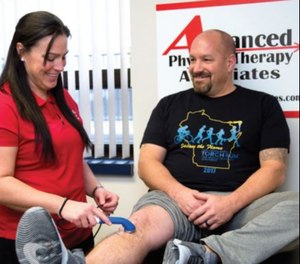 Strength and conditioning interventions are provided to officers on an as-needed basis. (Photo/Alan Kolbeck)
All that said, Chief Marty Skibba is a cordial host who has created a welcoming space. Speaking in quiet, measured tones, the articulate Skibba holds forth on a topic dear to his heart: the health and wellness of every officer under his command in the Stevens Point Police Department (SPPD).
“As cops, we aren’t always the best at taking care of ourselves,” he says. “We tend to look outward, focusing on what’s coming towards us, a lot of which is pretty tough stuff. That’s the job, and it’s what you do.”
Skibba sits for an hour, doing most of the talking because that’s why we’re here, to learn about the steps his department is taking to turn a little bit of that focus inwards, so the men and women tasked with keeping a community safe can be at their best.
Because when we need a cop, perhaps during one of life’s most challenging moments, they need to be at their best, because we just might not be.
************
While the incessant cliché of cops eyeing up a box of donuts within easy reach may never go away, think of this: most sedentary jobs don’t include the necessity of being able to go from a seated position to top speed in order to respond to an emergency situation that puts both body and psyche at risk.
Such stressors are not an employee norm.
And cops see a lot of things we don’t necessarily – or ever – want to see, not to mention deal with on a daily basis. Yet every officer, without exception, understands that witnessing trauma and devastation comes with the job.
Historically, law enforcement’s unwritten guideline for dealing with job stress was to suck it up and move on. The limitations of that mantra have long been known, but it takes time to move a needle and change a culture. That’s the goal of the SPPD wellness program.
And while he’s quick to point out the resolute efforts of previous Department members that laid the groundwork for the program as it exists today, Skibba’s unrelenting advocacy for the squad’s physical and mental well-being is noteworthy.
Additionally, there’s a giant stuffed elephant draped over the couch in his office, the plush embodiment of the Chief’s desire to always acknowledge the difficult, the painful, even the horrific, and let such things breathe.
“No matter how challenging your day is today, you need to come back tomorrow and confront that day,” he says.
Now there’s a mantra with immense potential for law enforcement, a group as strong and tight as they come.
Enter Advanced Physical Therapy & Sports Medicine’s Traci Tauferner, the long-time coordinator of the Department’s wellness program, who joins the discussion.
“This Department is definitely strong and tight, but it needs to be strong and flexible,” quips Tauferner.
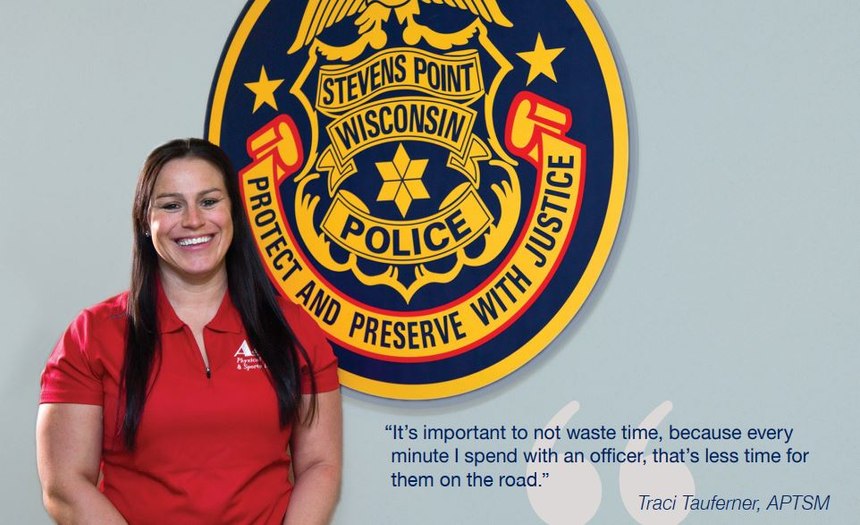 Athletic trainer Traci Tauferner, who coordinates the SPPD's wellness program, had to convince the officers she was on their side. (Photo/Alan Kolbeck)
Coming from an athletic trainer, the statement undoubtedly refers to the value of muscle pliability, but it also does double duty. Cops are not the easiest group in which to insert oneself, and that kind of inflexibility is exactly what Tauferner had to overcome to establish the program. Only with trust could there be acceptance, relevancy, success.
She would need to convince a decidedly insular group – the thin blue line – that she was on their side.
************
To get a sense of the current state of the SPPD officer wellness program, just follow Tauferner to her office.
It’s a long journey, but not because the office is located in a far corner of the facility away from any serious foot traffic. That was in the old days. The trek to her office is actually quite short, as it sits smack dab in the center of the stationhouse.
It takes a while because there is a conversation between Tauferner and EVERY member of the Department she bumps into, and that is no small number on this Wisconsin winter morning.
Tauferner’s experience working with tactical groups – police, firefighters, paramedics – puts her in the unique position of understanding the challenges these groups face as well as being able to do something about them. Every wellness program must be tailored to a group’s needs and, just as important, budget. At SPPD, the initial program was based primarily around fitness assessments that provide indicators for potential physical issues.
These assessments proved crucial in a number of ways:
The success of fitness testing led to program enhancements such as onsite rehab. Tauferner’s bread and butter are strength and conditioning interventions, which she provides to officers on an as-needed basis. Could be an officer experiencing a hitch in their giddy-up, or someone who needs help rehabbing after surgery. Perhaps it’s an ergonomic issue, where a computer needs to be moved or a chair requires an adjustment to provide relief.
Such visits often begin with the hope that a nagging pain can be addressed. This opens the door, providing an opportunity to broach other issues and bring them to light.
If Tauferner gets the call to work on a tight quad with ultrasound, cupping, or instrument-assisted soft tissue mobilizations, she knows this is the perfect time to make a few inquiries. And if that call isn’t made, officers still have required fitness testing three times a year.
“Many of the officers don’t see their primary care physician, so three times a year I am able to check in on their health, their blood pressure, their heart rate, their flexibility,” says Tauferner. “It’s an opportunity to start a conversation and suggest some help.”
To emphasize the point, Tauferner relates the story of a firefighter complaining of heartburn. No biggie he says, and he’s ready to shrug it off. Tauferner tells him to sit down so she can take his blood pressure. It measures 180/110.
“I suggest you go to the ER right now,” says Tauferner.
Turned out the officer was having a heart attack and had an arterial blockage in the left anterior descending artery commonly known by another name: “the widowmaker.” Following a flight for life, open heart surgery was immediately performed.
The officer frequently thanks Tauferner for her life-saving abilities; she points to the flight crew and hospital staff who provided care. Though minimizing her role in the outcome, she is a serious advocate for the testing she performs.
“He had symptoms that were questionable, and the assessment confirmed it,” says Tauferner.
And it all starts with a conversation.
She spots an approaching figure, laughs.
“That’s the belt guy I was telling you about,” she says, loud enough for Detective Lieutenant Bob Kussow to hear. “He’s put on some weight.”
Time to start another conversation.
************
In charge of the detective bureau, Bob Kussow oversees the work of SPPD detectives: two narcotics detectives, a white-collar crime detective, a general investigator, a sensitive crimes detective. Starting at SPPD as a patrol officer, Kussow would later work in sensitive crimes, then as a school resource officer, back to patrol as a supervisor, and from there in administration in charge of training, auxiliary and K-9.
“Yeah, I met Traci when she first started a weight loss competition here. That first year I actually kept adding holes to my belt because I was losing weight pretty good,” says Kussow. “Had a bit of a setback this year.”
Prior to his “setback,” Kussow made some changes: improved eating habits (subject to change), the addition of cardio to workouts consisting mainly of lifting, running a few 5Ks, the adoption of a more open mindset (“I gotta do something about this”).
And he stuck with those changes for the most part, until an injury last year. A member of the Department’s SWAT team for 18 years, Kussow was no stranger to the yearly training drills done with other law enforcement agencies at Fort McCoy. As he was looking to transition out of SWAT, the 2019 training session was to be Kussow’s last.
He made sure of that with a single jump.
The two-day session starts with an obstacle course, one Kussow had conquered many times before. You can see where this is headed.
“Of all the equipment we did, walls we scaled, all that stuff, this was a four-foot wall that you jump over and land in a ditch on the other side. The easiest thing, really,” he says.
Kussow stuck the landing and tore the meniscus right off the bone. He’d continue the course, which ended with a long stretch of monkey bars and a significant drop. His compatriots knew Kussow was hurting and were there to help him finish the course.
Following surgery to reattach the meniscus to his right knee, it was six weeks before Kussow could put any pressure on it. He then began seeing a physical therapist three times a week, and Tauferner worked with him on the other two days upon his return to SPPD for light duty.
Goal number one for Tauferner was to help Kussow get back range of motion. Working in concert with Kussow’s surgeon, Tauferner pushed him to get back to where he needed to be. Tauferner was, in the words of Kussow, pretty tough.
Credit her military background. Or her vast knowledge of strength and conditioning interventions. Either way, Kussow was getting back to full strength.
At the time of his interview, Kussow was almost 21 weeks out from surgery and way ahead of schedule. Tauferner put Kussow through testing he had to pass before he was cleared to return to full duty, tests which included lifting weights, running, and jumping fences.
He finds himself in a good spot now, and he credits the support system that SPPD has in place.
“You can tell that the physical and mental health of the squad is very important to the Chief,” says Kussow. “And in order to have good mental health, you have to have good physical health.”
Just down the hallway from Tauferner’s office is a well-equipped gym providing easy access to treadmills, weights and other workout equipment – mostly donated – for officers to use before or after shifts as needed, to get the adrenaline out after a tough day.
Another program enhancement, and another opportunity to change the culture.
************
When starting a program, initial conversations about wellness tend to be broad in scope. Chief Skibba has been around long enough to see the trajectory of the program at SPPD and how those conversations have changed.
“We might have begun with a general notion of getting officers in better shape, say, how many push-ups or sit-ups can you do?” says Skibba. “But with Traci’s help and a fresh set of eyes, we were on a track to take things to the next level.”
That means bringing relevancy to testing by looking at job requirements. Instead of a test that simply measures running speed, you measure the length of your high school to find out how far an officer would need to run in order to clear a school. Instead of a simple climbing test, you find the city ordinances that specify how high the fences are that officers must be able to climb. And you factor in the amount of gear that is worn.
“Now we have testing that is relevant to what our community expects officers to be able to do,” says Skibba.
Tauferner speaks to the trajectory of the fitness testing as well, the initial focus of which was the Functional Fitness assessment, which tests body composition, waist circumference, functional movement, and cardio.
In the early stages, Tauferner conducted the assessment four times per year, and there were a lot of below-average scores on the exams, which indicated a need for improved levels of fitness. Over the course of the program, scores have improved significantly, so much so that Tauferner recommended reducing the number of times per year the test was given.
With the betterment of scores, new questions arise: Are we satisfied with where we’re at? What steps can we take to get to the next level of improvement? Are there other factors we need to consider?
With SPPD, Tauferner also utilizes a Functional Movement Screen (FMS), a test first widely used in the military to assess basic body movements to ensure service members would be able to perform assigned military duties. A test with obvious crossover capabilities for other tactical groups, FMS identifies strong predictors of future injury risk – deficiencies in balance, core stability, flexibility, and mobility – through a series of specific movements.
Used in concert with physical fitness testing, the FMS is key to developing appropriate and effective injury prevention programs, says Tauferner.
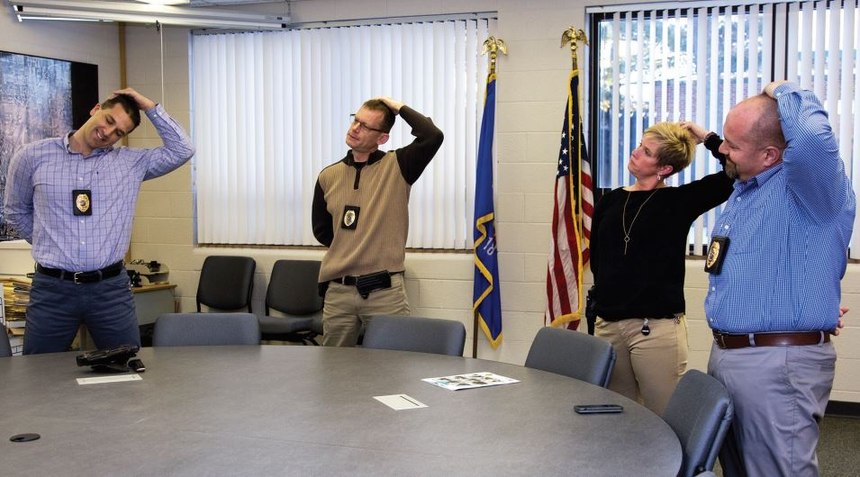 Stretching during briefings is a daily occurrence at SPPD. (Photo/Alan Kolbeck)
The relationship between Tauferner and the SPPD that began a decade ago set the stage for a more comprehensive program that would better meet the needs of a growing community with the concerns that affect cities across the country regardless of size.
Police departments are addressing an ever-growing number of issues. Coupled with the expectation of digital world response times, this equates to increasing responsibility and greater workloads, underscoring the importance of keeping injuries to a minimum and quickly and safely return those injured to their posts.
To meet those needs, the SPPD officer wellness program includes the following:
Tauferner stresses the importance of each program component to act as a touchstone with Department members, as well as to contribute to a culture of wellness. It’s this mindset that continues to drive the program, putting the Department in the position of knowing exactly when an officer is ready to take care of the community in whatever fashion is needed.
************
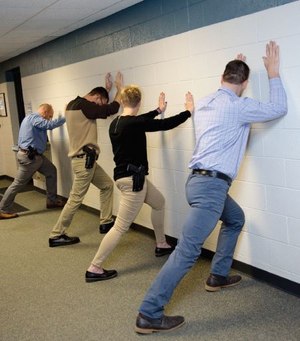 "When we don't include stretching in our routine," says Kussow (far left) "we actually miss it." (Photo/Alan Kolbeck)
As with anything funded by tax dollars, you better be able to show a return on your investment. Skibba is confident the Department is being fiscally responsible with the wellness program.
Nonetheless, some will ask why such a program is necessary.
While corporate health and wellness programs are common practice in businesses, the same is not the case in the law enforcement world, where such support is crucial. Yet across the country, many police departments are resistant to such trends.
In many cases, decision-makers need to spearhead such initiatives. Skibba asserts there has been a long history of such leadership at SPPD. He feels the program is well-established and has momentum.
He adds another item of note.
“Job injuries have gone down considerably,” says Skibba. “The savings from that perspective alone are considerable.”
Skibba credits Tauferner with elevating the program to where it is now, and Kussow agrees.
“Traci has been the inspiration to get the Department on a healthier track,” says Kussow.
Tauferner is back in the hallway, engaging with her team, trading barbs, asking what’s up, offering the highly sought after let’s see what we can do, getting to as many officers as she can. She moves quickly; time is of the essence.
“It’s important to not waste time, because every minute I spend with an officer, that’s less time for them on the road,” she says. “Taxpayers are paying for all of our services, so we need to be mindful of how we can make those dollars go the furthest and be put to the best use.”
************
A proud NOVO Health Partner, Advanced Physical Therapy & Sports Medicine specializes in onsite therapy services, injury prevention, job site analysis and first aid to decrease OSHA recordables.


 © Miguel Riopa/AFP/Getty Images


